
Test drive E/M-Code-Sense AI for free.
Experience the future of E/M coding firsthand. Sign up today and process your first 15 charts entirely on us. See how instantly calculating MDM vs. Time can protect your practice and optimize your reimbursement.
No credit card required.
Case of the Week
Emergency Department: Chest Pain
Test our new E/M Code-Sense AI! Copy the clinical note below and paste it directly into the calculator to see the audit-proof code instantly.
Click to Reveal the Answer & Analysis
The Correct, Audit-Proof Code Is:
99285
This is a textbook example of High Complexity Medical Decision Making across all three categories in the ED. The correct code is 99285.
See How E/M-Code-Sense AI Solved This Case
Stop leaving money on the table. Watch how our new AI Auditor handles high-complexity scenarios, validates your ICD-10 medical necessity, and proves your MDM level in seconds.
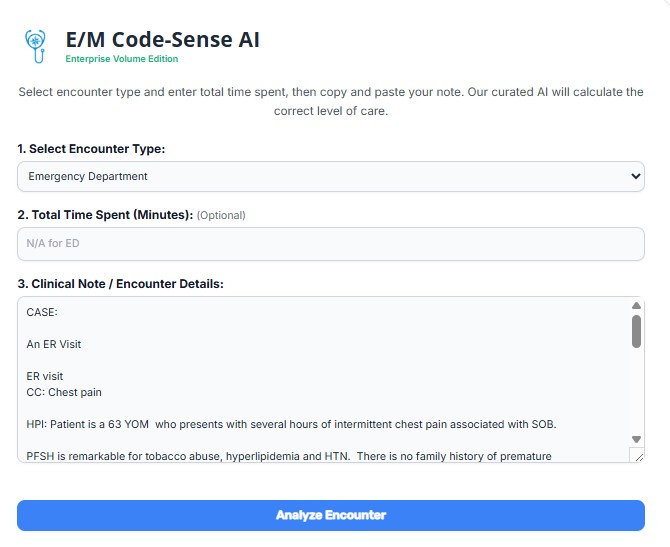
Step 1: Feed the AI
-
ASelect Encounter: Emergency Department
-
BEnter Note: Paste the raw clinical text.
-
CClick Analyze: Let the engine do the work.
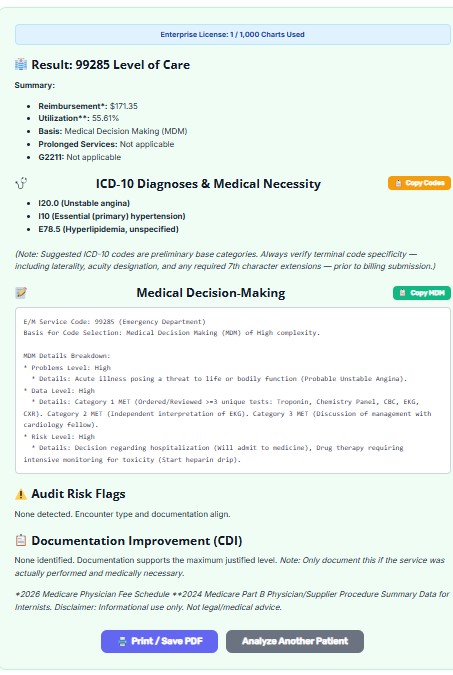
Step 2: Get Instant Results
- ✓ Result is 99285 Level of Care
- ✓ AI verifies ICD-10 Medical Necessity
- ✓ AI identifies ED exception to Time-based billing
- ✓ 1-click EHR Coding Rationale generation
Stop leaving legitimate revenue on the table.
Unlock E/M-Code-Sense AI TodayPackages start at just $99/year.
Detailed Manual Analysis
The 2023 AMA guidelines brought major changes to most encounter types, but Emergency Department visits remain a distinct exception to the Time rule.
Time-Based Result: N/A
Emergency Department visits (99281-99285) cannot be billed based on time. Because ER services are provided on a variable intensity basis involving multiple encounters with multiple patients over an extended period, time is explicitly removed as an option. You must use MDM.
MDM-Based Result: 99285
The overall MDM complexity was determined to be High. Because we must use MDM, this high complexity directly translates to the highest level ED code: 99285.
MDM Deep Dive: The "2 out of 3" Rule
To achieve a High score, you need two of the three components to hit the "High" level. This chart actually maxes out all three.
Problems Addressed: High
The patient presents with "Probable Unstable Angina" (USA). This is a textbook example of an acute or chronic illness posing a direct threat to life or bodily function.
Data Reviewed: High
You scored points in all 3 Categories! You met Category 1 by reviewing multiple unique labs and a CXR report. You met Category 2 by providing an independent interpretation of the EKG. You met Category 3 by discussing the case with the Cardiology fellow. (2 out of 3 = High).
Risk of Complications: High
The decision to admit the patient to medicine qualifies as a "Decision regarding hospitalization", and the order to start a Heparin drip qualifies as "Drug therapy requiring intensive monitoring." Both satisfy the High Risk threshold.
The "2 out of 3" Rule Confirms High MDM
Because all three components met the highest possible thresholds, the final MDM code is indisputably High.
Data
HIGH
Risk
HIGH
(Middle Value)
Problems
HIGH
The middle value is High, which becomes the final MDM level.
Sign up for our Physician-to-Physician E/M Coding Courses
Stop guessing and start coding with confidence. Learn outpatient and inpatient E/M with step-by-step, real-world clinical examples designed to improve documentation, optimize reimbursement, and protect you in an audit.
Choose the curriculum that fits your practice, then start today—self-paced and on-demand.